Remembering a Legend

[In memory of the late Bhai Avtar Singh Ragi: January 8, 1925 – November 24, 2006]

My introduction to Bhai Avtar Singh was in the late 1970’s. Okay, to be fair…I was only a toddler and my family was hosting a kirtan at our home in memory of my great-grandmother who had recently passed.

Maybe it was only a coincidence that the famous ragis, Bhai Avtar Singh and Gurcharan Singh, sons of Bhai Jawala Singh and 11th generation kirtanis, were passing through Washington D.C. and were available for kirtan seva that morning.

Perhaps it was only a coincidence that my great-grandmother herself enjoyed listening to their kirtan very much. And maybe it was also a coincidence that two of her own sons were in fact named…Avtar Singh and Gurcharan Singh.

Coincidences aside, it was the beginning of a very special relationship.

I can’t say I remember much from that kirtan, but my father did request Bhai Sahib to sing Ab ki baar baksh bande ko and the recording of that shabad has been etched in my childhood ever since.

Two decades would pass before our paths would cross again. This time, through my friend’s CD player in his car soon after Gurmat Sangeet (1999) was released. Although I enjoyed listening to kirtan, personally, I preferred a more popular form of kirtan with a faster tempo.

However, being that my friends were big fans of Bhai Avtar Singh and we listened to and sang kirtan together a lot, I was repeatedly exposed to Bhai Sahib’s reets (musical compositions)…and eventually, it grew on me. I particularly connected with Mero sundar kaho milay kith galli in Raag Devgandhari and Rattay ishq khudaae in Raag Asa.

With some help, I also learned how to play the latter on the harmonium, by thumbing through Gurbani Sangeet Prachin Reet Ratnavali, a book authored by Bhai Avtar Singh and Bhai Gurcharan Singh, wherein they have transcribed hundreds of musical compositions that have been performed in their family for centuries.

I was lucky that Bhai Sahib was well recorded. There was an abundance of tapes, CDs, and MP3s available of professionally-recorded as well as live kirtan. I compiled nearly a full collection of his work and listened to it at every opportunity I had.

After spending years absorbed in his 31 Raagas (2001) CD, I had the great fortune to listen to Bhai Avtar Singh live as he was passing through Chicago on his 2003 North American tour.

The first shabad I heard him sing live was Mohan neendh na aaveh in Raag Bilaval. A soon as he began the manglacharan, my eyes welled up. I’m not sure what it was. Perhaps it was the crackle in his voice that reminded me of a different era, or maybe I was feeling nostalgic of the recording I grew up with, or maybe it was the fact the shabad was sung in the same raag, feeling, and emotion in which my Guru wrote and sung it himself. Whatever it was…I was hooked.

I had the opportunity to listen to Bhai Sahib and his jatha, which included his son Bhai Kultar Singh and nephew Bhai Swaran Singh on the jori, on their two subsequent trips to North America in 2005 and 2006.

Bhai Avtar Singh’s last visit was most special to me in that in that I got to hear him perform kirtan while playing the Taus – a traditional string instrument he had not played for decades in favour of the more popular harmonium. It was breath-taking!

Although I enjoyed listening to Bhai Sahib do kirtan at the Gurdwara during his visits, it was the private concerts at people’s homes during the week I enjoyed most. Often times I would arrive early before work, right as Asa Ki Vaar would start. In that intimate setting, early in the morning with only a few people present, the experience was magical. Especially with the tanti saaz (traditional instruments), all I would do is close my eyes, and I would feel as though I was in Guru Nanak’s darbar – with Bhai Mardana plucking the rabab and baani flowing through the Guru.

I try not to put kirtanis and raagis on spiritual pedestals, but I do have tremendous respect for Bhai Avtar Singh for his 60 years of kirtan seva, his complete mastery of the art, and for preserving the tradition of Gurmat Sangeet.

On a personal note, his kirtan has touched five generations of my family, from my great-grandmother (the matriarch of our family), to my children – who have been listening to Bhai Sahib, even before they were born! What a beautiful link we all share in common…

Although I have listened to all types, Bhai Avtar Singh’s style of kirtan, with all the love and emotion he expressed it in, is what I’ve connected with the most. It has exposed to me the world of gurmat sangeet, which has encouraged me to understand and reflect on baani rather than simply listening to it. All of which (with His Grace) will bring me closer to the Guru.

For that, I am eternally grateful.

I thank Bhai Avtar Singh for helping shape my Sikh experience and thank Waheguru for giving us this rare gem of a man for a wonderful 81 years.

November 24, 2009

The Magic of Saakhis

I have always loved listening to saakhis.

All kinds…from stories about the Guru’s childhood and their travels, to the tales of courage and bravery of the Khalsa on the battlefield – there is nothing I loved more than to be transported to the era of my Gurus and the heroes of our faith.

Whether it was at home, the Khalsa School, or Gurmat camp, I would take every opportunity I could to listen to a saakhi about Sikh history…my history.

Much of that enthusiasm carried through my childhood, but as an adolescent, I started listening with a more critical ear. I remember once at camp, a teacher shared with us the story of Vaisakhi.

I’d heard the story hundreds of times, but it was one my favourites, so I listened attentively. As he told us about the Guru’s call to the crowd that day and finally one man standing and offering his head, he said that Guru Sahib then “brought him in to an enclosed tent and returned minutes later with a sword dripping in blood.”

Wait!…What? Sword dripping in blood? Where did this come from? I immediately raised my hand, and the instructor explained that Guru Sahib had slaughtered a goat behind the tent. I never heard this before. Why would Guru Sahib need to fool the crowd in this way? Weren’t they shocked enough that he was asking for a head in the first place? Why did this saakhi have to be unnecessarily embellished? I wondered how many other different “versions” of the saakhi were out there.

After much debate on this saakhi with the instructor and friends, I started re-thinking many of the saakhis I grew up with. Unlike gurbani, many of these stories have been passed down generations through oral tradition and have only recently been documented in the last hundred or so years, so how do we know what is fact and what is fiction?

Especially those that border the realm of logic…the ones I was always amazed by. Did Baba Deep Singh really fight in battle with his head in his hand? In Mecca, did the Kaaba really move to the direction of Guru Nanak’s feet?

I remember a student asking me at Gurmat camp once why Guru Nanak stopped a boulder with his bare hand if the Gurus were averse to using “magical powers.”

Although I started to doubt many of the saakhis I grew up with, it did not shake my faith. In fact, what inspired me most of the Guru’s lives were some of their worldly accomplishments – they were artists, poets, soldiers, human rights activists, environmentalists, city planners, architects, businessmen – all while living a productive family life.

The fact that Guru Sahib took a stand against the caste system at age 9 by refusing to wear the Hindu janeeo…this is what amazes me! The fact my Guru directly challenged oppressors like Babar during his brutal invasion and called him out as a tyrant…this to me is the magic of Guru Nanak!

Furthermore, some of these “super-hero” like saakhis that defy reality can be harmful too. Why would we want to make the Gurus larger than life and further distance ourselves from them? Maybe this is why people have resorted to babas and other intermediaries because we have made the Guru so “off-limits.” After much thought on this, I stayed away from these “questionable” saakhis at camps and retreats and focused on those that were more logical or could be supported through bani.

Many years have passed and as I’ve started telling saakhis to my own children, I find myself with a dilemma. Part of me wants to tell the same stories I was told as a kid, so I can see their eyes light up in enthusiasm and amazement, the same way mine did…even if the stories are a bit exaggerated.

Although I’ve decided to share only those saakhis that seem more realistic and practical, I still tend to “leave a little room.” As I’ve discovered on my journey of Sikhi, the more I learn, the more I realize I don’t know. The fact of the matter is, I wasn’t there when Guru Sahib squeezed milk from Bhai Laalo’s bread and blood from Malik Bhago’s. I wasn’t there when he stopped the boulder with his hand. I wasn’t there when Guru Sahib asked that his feet be moved away from the direction of the Kaaba…so perhaps I shouldn’t let my parameters of logic restrict my understanding of history.

Maybe through simran, further reflection, and learning…my parameters will also change.

We come from a rich and proud history. And as we individually connect with the events through our story-telling tradition, there is likely to be variation in the ways our stories are told. What is more important is that we are able to extract the central message – whether it is equality, truth, justice, or compassion.
I hope that saakhis continue to inspire generations to come and the eyes of Sikh children (and adults) continue to light up with these tales of compassion, courage and heroism.

Because when a saakhi from our history is conveyed with enthusiasm, emotion, and love…it is nothing short of magic!


A Little Outrage

I was really moved by this audio essay from Cecilia Muñoz titled “A Little Outrage Can Take You a Long Way” on NPR’s This I Believe segment.

In her reflection on activism, I connected with the statement about defeats outweighing victories, and how it motivates her to continue her work. Like many of the TLH readers, I too take time out my schedule for service activities. And after serving 100 or so meals at a homeless shelter, I go home feeling good about myself and the good deed I had done. Unlike Muñoz, I don’t stay awake thinking of the 100 or so people who were turned away that day at the shelter, or those who wouldn’t have a place to sleep that night. Maybe this is what separates me from real activists. To me, service has become an event or an activity – for an activist, service is a part of their life…part of who they are. They are constantly looking for ways to serve.

And I agree with Muñoz, “a little outrage can take you a long way.”

Although I don’t believe Guru Nanak was motivated by anger, I do believe he was outraged. Outraged by a society complacent with the rigid caste hierarchy, outraged at the imbalance of justice, and outraged by the barbaric methods of the State to suppress a minority. You can almost hear the outrage, when Guru Sahib describes the horrific events of Babar’s invasion:

eaethee maar paee karalaanae thai(n) kee dharadh n aaeiaa
There was so much slaughter that the people screamed. Didn’t You feel compassion, Lord?

But in the brilliance of Guru Nanak, he managed to channel that outrage in to compassionate activism.

As a child, attending Khalsa school and camps – I would learn about these different facets of Guru Nanak’s life and teachings. But to be honest, I struggled to understand the spiritual elements – concepts like Naam, Kirpa, Jeevan Mukti, all of these were abstract…I didn’t really “get it.” But when I read about Guru Nanak’s history and his activism…that, I got. When Guru Sahib at age 9 rejected the caste system by refusing to wear the janeoo…I got it. When Guru Nanak directly challenged the oppressive ruler Babar, during his invasion in the early 1500’s, and called him out as a tyrant…I got it. When he established the concept of Langar, where no matter what caste, creed, religion, or socio-economic group you were a part of – everybody sat together on the floor to share a common meal, and by doing so shook the very core of the caste system…I got it! It made sense to me. I connected with it.

And now as I’m slowly grasping a bit more of the spiritual elements of Guru Nanak’s message and putting the pieces together – I’ve learned that in Sikhi, spirituality and a connection with God (as essential as it is) it is not an end itself. Guru Nanak, with all his knowledge and piety, did not retreat to the hills and have followers come to him for advice. No, instead…he became an activist, an activist for the defenseless – to create a society based on complete human freedom and equality. Guru Nanak, and the Gurus to follow, were advocates for social justice, culminating in Guru Gobind Singh establishing the Khalsa with the deliberate plan that the down-trodden, even the out-castes, achieve social equality and capture political power.

Based on the examples the Guru’s have set for us, I believe that being an activist is a requirement for a Sikh. But how do we become and foster activists? As a parent, I’m always trying to think of ways I can teach Sikh principles to my children, and I know for many of the customs, rituals, and routines of a Sikh – they will learn it – through camps, through Khalsa schools and other structured learning. But when it comes to activism, such an essential part of our faith…I believe it will only be learned through example.

So perhaps I need to be a little more outraged. Or at least not get too comfortable. Maybe I need to keep a part of me always a little restless…searching for ways I can help a cause. I know there is so much injustice in the world. I know there is so much that would affect me, if I only cared enough to look.

Right now, somewhere in this world, there is a cause that needs my voice, a movement that needs my pen, and a march that needs my feet. Somewhere there is a fist I can raise, a rock I can throw, a fight I can fight, or a compassionate hand I can lend…all I have to do, is care.

This is the example Guru Nanak has set for me. The only question is…what am I going to do about it?


To The Last Hair, To The Last Breath

A few weeks ago, while at the park with my family, an elderly woman dressed in a sari came over to say hello. After a brief introduction, she said to us “wait here for a second” and called out “Alex…come here!” A little boy with light skin and brown hair ran over to us. The lady in the sari bent down and said to Alex, “See…this is what your grandfather looked like. He wore a turban and had a long beard just like him.” Alex wasn’t quite sure what to make of it, but he forced a quick smile and ran back to the swings.

As a dastaar-wearing Sikh, I come across these interactions quite often – some pleasant, some not-so-pleasant, and some downright awkward. But because they happen so frequently, I tend to brush it off and forget all about them quickly. For some reason, this incident stuck with me.
It made me think about the days in Gurmat camp decades ago when the Uncles would scare us in to keeping our kesh or else keshdari Sikhs would become a “thing of the past” and “only be seen in museum exhibits.” I never bought that theory, but the incident in the park did shake me a bit.
Although Sikhi is such a large part of my life, truth is…I really don’t think about kesh much. As a matter of fact, when I lead presentations about Sikhi to Sikhs or non-Sikhs, I make a point to downplay the kesh aspect. Not that it is any less important than any of the other kakaars, but with non-Sikhs, the “mystery” behind the kesh seems to overtake discussions, and we miss some of the most important and central tenets of the faith…equality, self-less service, self-realization, and universality of the message. And even with Sikhs, kesh is made such a focus that many in our community feel that as long as we retain the external image of a Sikh, the rest of maryada and discipline does not apply. It is essentially a “free-pass” and gives us the right to criticize those who do not keep their kesh.
Being the only Sikh boy in my school in the early 80’s was difficult and I always questioned why I needed to keep my kesh in the first place. I was given all kinds of answers – some said it was Guru Sahib’s way of giving us a unique identify we “couldn’t run away from” after the circumstances of Guru Tegh Bahdur’s shaheedi. Some said that hair has traditionally been a sign of saintliness, as many other saints from other religions kept long hair. Others said we should not cut something that grows naturally from our bodies (yes, the finger nail debate would quickly follow), while others gave more “alternative” reasons – that hair served as “antennae” to gather and channel energy from the sun. At a recent seminar I attended, one of the more “scholarly” elders referred to kesh as a “custom” and well, customs after time…do change. I’ve heard just about everything. Strange how I was so consumed with this question throughout most of my childhood and adolescence, but as I’ve gotten older and learned more about Gurmat, I’ve started to wonder less and less about it. Instead, I’m consumed with what I find difficult now – waking up at amritvela, focusing on my paath, being compassionate and forgiving, letting go of my ego, attachment, and anger, seeing Waheguru in everyone…it’s as though keeping my hair is the easiest thing my Guru has asked of me…I mean, I don’t even have to try! And for everything my Guru has given me, isn’t this the least I can do as an expression of my love?
In the end, we all have to come up with our own reason. Personally, I keep my kesh because my Guru has asked this of me…and I accept it as his gift – that’s it. It is neither a symbol nor a custom…it is a part of me…a part of my history. It is what Bhai Taru Singh gave his life for rather than a strand be cut. It is what Sikhs all around the world reflect upon daily in our Ardas, remembering those who gave their lives, “Kesan Suasan Naal Nibaahi” (with their hair intact, to the last breath). Just like a soldier wears his/her uniform proudly because it reflects the principles and tenets for which the country stands…my kakaars serve much the same…it represents the principles and tenets of my faith…equality, justice, service, compassion. And every time I stand before a mirror I am reminded of those principles and the code by which I live. Everyone around me is aware of it too…I cannot run away from it. And if my appearance means I am excluded from joining my co-workers at the bar after work or I’m randomly selected at airports from time to time…so be it. It is an honor and a privilege to bear the image of the Khalsa. And with my Ardaas and His grace, I shall live up to the ideals for which it stands.
Just about everybody I talk to or every article I read about the state of the panth tells me much the same…youth cutting their hair, trimming their beards, moving away from Sikhi etc. etc. Although I don’t ignore the realities of our situation, I don’t dwell in it either…I choose hope instead. I’m convinced through further reflection of our history, our traditions, and inspiration through Gurbani, we (individually and collectively) will reflect the Guru’s love and message. I look forward to a day at the park where a mother will bring their child over to us, lean down and say “This is a Sikh family…if you are ever in need…you can always count on them to help!

Half The Sky

The issue of forced marriages and domestic violence clearly struck a chord with many of the TLH readers. But somewhere deep in the comments over titles, or whether these are Sikh or Punjabi issues, or whether or not we should air our “dirty laundry” in the first place – I feel some of the issues themselves got lost.

In formulating my own thoughts on the topic and trying to build a broader perspective on women’s issues in general, I came across a fascinating article in last week’s New York Times Magazine called “Saving the World’s Women.” The premise of the article is that many of the countries that are disproportionately poverty-stricken and absorbed in fundamentalism and chaos, are also those same countries where women are the least educated and most marginalized. And by focusing (and investing) on women and girls, a dramatic impact can be made to fight global poverty and extremism.

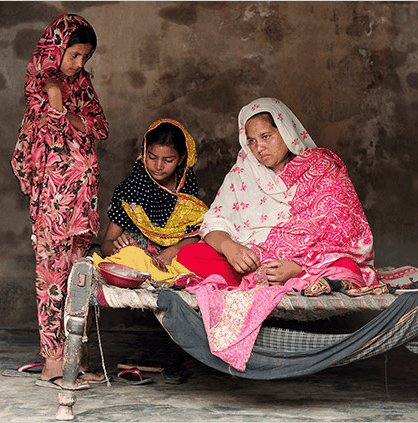
Take the example of Saima Muhammad (pictured above) from Pakistan. Saima didn’t have a rupee to her name, was routinely beaten by her unemployed husband and other family members, and had to send her kids away due to lack of food and other basics. Even her mother-in-law contributed to her troubles by encouraging her son to marry again because Saima was only giving birth to girls. However, after Saima signed up with the Kashf Foundation, a Pakistani microfinance organization, things turned around.

Saima took out a $65 loan and used the money to buy beads and cloth, which she transformed into beautiful embroidery that she then sold to merchants in the markets of Lahore. She used the profit to buy more beads and cloth, and soon she had an embroidery business and was earning a solid income — the only one in her household to do so. Saima took her elder daughter back from the aunt and began paying off her husband’s debt.

…Saima became the tycoon of the neighborhood, and she was able to pay off her husband’s entire debt, keep her daughters in school, renovate the house, connect running water and buy a television.

As the economics of Saima’s situation changed, so did the relationship with her family. She now has a better relationship with her family and has earned their respect. It is unfortunate that this is what it took for Saima, and many will never have the golden opportunity Saima had, but it does send a clear message – that although it may seem impossible to break down cultural barriers, economics can change the game quickly.

The article explains case after case of how investment in women’s education and assistance in starting businesses can help impoverished women support their families, communities, and country – “They represent the best hope for fighting global poverty.”

Some of the author’s arguments seem a bit far-fetched based on their evidence. They claim that the “little secret” of global poverty has much to do with unwise spending by the poor-especially men, and that women are more likely to spend on family needs, health, and education more so than men. That could be debated at a family level, but a macro level, I feel we cannot realistically measure this until women hold more offices of power in these countries. But to be fair, this article was adapted from a book “Half the Sky: Turning Oppression Into Opportunity for Women Worldwide“, due to be released next month…perhaps I’ll be convinced after reading the full book.

What I liked most about the article was that it offered specific solutions and recommendations. It outlined an agenda on what “fighting poverty through helping women” might look like, based on studies by respected economists., more than just “throwing aid” to developing nations. It also explained models that have produced results in other countries. So you may be wondering…(and hopefully I’ll save a few angry responses)…what does this have to do with us? That’s simple:
– The UN has estimated that there are 5 million honor killings a year
– 130 million around the world have been subjected to genital cutting
– 1 percent of the world’s landowners are women
The list goes on and on…

This is not a Punjabi issue or a Sikh issue…this is a human issue. We know how our Gurus (through Bani & history) promoted gender equality, and one of the commenters last week beautifully laid out examples of courageous women throughout our history…from the stories of Mir Mannu’s prison to Mai Bhago and the women who fought alongside her. So if we are to be “activists of the world” why shouldn’t we be at the forefront of this cause? Shouldn’t our Sikh NGO’s work with President Obama’s new White House Council on Women and Girls? Shouldn’t our Sikh institutions partner with organizations like CARE, that works alongside poor women in fighting global poverty? And shouldn’t we create our own organizations that serve as a forum for discussion and activism both for global women’s issues and that of our local communities? And what about the author’s theory on how such focus can address global poverty…doesn’t that affect us? And even if we prefer to believe none of these issues currently affect our Sikh and Punjabi communities – given the proximity of where the article’s examples take place (several references to India and Pakistan) and similarities in culture, should we not be proactive in preventing it? Perhaps by implementing some of the recommendations the article suggests at a micro level, we can mitigate the issues discussed in previous posts on forced marriages and domestic violence.

I don’t believe there is any “silver-bullet” to addressing the issues above, but I’m glad to see TLH and its active readership discussing and debating them. As the Chinese saying goes, “Women hold up half the sky”…the issues affecting women cannot be silenced.

I look forward to hearing other’s thoughts and comments on the linked article!

The Wheat Of Compassion

I’ve always enjoyed a good story…and amongst all the depressing news lately of our declining economy, raucous town hall meetings, and corrupt politicians…I often turn to StoryCorp’s podcasts for a quick “pick-me-up.” A few months back, I came across a beautiful piece titled “Finding El Dorado.” It’s the story of Gus Hernandez and the unique friendship he developed with Siddiqi Hansoti as a result of the current economic crisis. I was moved by this simple story of compassion and the power of the human spirit. Take a listen…it’s only 3 minutes [link].
This story got me thinking about compassion and what it means to a Sikh. After some brief research, I found dozens of references to Daya (and its variations – Dayal, Dayala etc.) in the Sri Guru Granth Sahib Ji. Depending on the context, it is loosely translated as compassion, mercy or pity. Several times it is used as an attribute of Waheguru:

miharavaan kirapaal dhaeiaalaa sagalae thripath aghaaeae jeeo
He is Merciful, Kind and Compassionate. All are satisfied and fulfilled through Him.

Other times it is used in the context of an Ardaas:
jath sath chaaval dhaeiaa kanak kar praapath paathee dhaan
Please bless me with the rice of truth and self-restraint, the wheat of compassion, and the leaf of meditation.

But what I connected with the most was how compassion was described as a necessary attribute of the GurSikh:

dhaeiaa kapaah santhokh sooth jath gantee sath vatt
Make compassion the cotton, contentment the thread, modesty the knot and truth the twist.

eaehu janaeoo jeea kaa hee th paaddae ghath
This is the sacred thread of the soul; if you have it, then go ahead and put it on me.

If this line sounds familiar, it is because it is often associated with the saakhi of Guru Nanak Patshah at the age of 9, when he refused to wear the janeeoo that discriminated him against the rest of humanity. By rejecting it, he rejected the ideology of the caste system that pervaded throughout society.

It’s fascinates me that he cites “compassion” in this act of rebellion. In fact, wasn’t the act itself an act of compassion? Not only empathy toward those who suffered from the rigid caste system, but a genuine desire to alleviate it? Was it not through compassion that Bhai Khanaiya committed the rebellious act of serving water to wounded soldiers of the enemy’s camp? And was it not through compassion that Guru Tegh Bahadur Patshah gave his life for all those suffering religious persecution, and to protect the freedom of choice?

It makes me wonder…in my own small acts of rebellion or activism, have I ever felt such compassion?
After listening to Mr. Hansoti’s act of kindness to a stranger and the examples of compassion throughout our history…I wonder if, outside of my family, I have ever completely let go of my ego and truly been compassionate toward someone else…or if there was a time I could have been more empathetic?
I am convinced that compassion brings us closer to the Guru and helps break the barriers of ego that separate us from Him. As a dear GurSikh friend of mine has said to me, “If there is compassion in your heart, you will never be alone.”

In all my ponderings and analysis of compassion, I’m reminded of a quotation from Saint Thomas Aquinas, where he said, “I would rather feel compassion than know the meaning of it.” Hoping to “feel”…striving to be a better Sikh…

My Ride Home

In my years as a consultant, frequent travel became routine. Waking up early Monday morning, cab to the airport, checking in baggage, waiting in lines, secondary screening, waiting in the plane for takeoff…by the time I reached my destination to start the work day, I was already beat!

But in this mundane ritual of a road warrior, I always took a moment of pause as I reached my destination and exited the airport. I would pan across the sea of yellow taxis looking for something familiar…yes, a dastaar!
Call it “reverse racial profiling” if you will, or maybe this is just my small way of creating some balance in the world – nevertheless, it is always a treat to find a Sikh taxi driver to share a ride with.
Even though we are complete strangers, the taxi driver is immediately my Veer or Uncle, and it is like we are meeting again after many years. We share a common guide and a common experience, and that is enough to bypass all the small talk.
It seems they are just as happy to have me as a passenger as I am to have them as a driver. For me – one who has always been intrigued by the “Sikh experience” – it’s a chance to converse with another Sikh about faith, politics, family and everything in between. Also, since many of these Singhs are recent immigrants, it gives me a glimpse in to the lives of my brethren in Punjab and the challenges and struggles they face in adjusting to their new life…neither of which I have much insight into.
I’m sure they enjoy the conversation in the same way, or at least enjoy the opportunity to speak Punjabi and have cultural dialogue with one of their passengers. Some compliment my Punjabi and ask which pind (village) I’m from, while others joke about my poor accent and grammar, asking when my parents came to America…but nevertheless, they are equally proud to see another Singh.
The conversations are light-hearted, friendly, and always seem to end in debate over accepting my cab fare – they insist I don’t pay! That only gives way when I repeatedly argue that my fare is reimbursed.
These taxi rides are often informative, where I can find out about local gurdwaras and events, and at other times resourceful. I recall one time, while travelling abroad, after some conversation with the driver, it turned out he was on the management committee of the local gurdwara. After further discussion over the projects I was working on in the States, I found myself at the gurdwara that weekend running a Sikh history workshop for the teenagers.
But one experience stands out the most.
Years ago, I missed my flight at the local airport and needed a ride to a neighboring airport about an hour away. The Singh taking me there was pretty quiet, but half way through the ride he asked me if I knew my paatthmujabani” (by memory). He immediately called another Singh on his cell phone, and asked him to call another. Then he handed me the phone.
I have found sangat and enjoyed Sodar in many places over the years, but scattered amongst several taxis across the Tri-State area is definitely a first! That night, I probably would have just rattled through my paatth as soon as I got on the plane. But sharing that experience with the sangat of the airwaves from a moving cab, was truly memorable. His eagerness to use this opportunity with a Sikh passenger to reflect in shabad was inspiring, and made me re-evaluate my own relationship with my nit-nem.
No matter how many people I meet in my professional career, I’m unlikely to meet as many people with such diverse backgrounds as these taxi drivers do. To many passengers, they will be the first Sikh they meet or maybe the only Sikh they will ever meet, so in a sense, they are ambassadors…ambassadors on wheels. And they will share the virtues of Sikhi, if not through dialogue, then at least through their kindness, compassion and professionalism.
My business travel days are mostly over, and I can’t say I miss it much. But I do miss the rides and conversations with the Singhs when our paths would occasionally cross. But I rest assure, knowing that in any country I may visit, anywhere in the world, amidst the hustle and bustle of a busy city, I will find a Singh driving a taxi, proudly in his Sikhi saroop.
Then, I will know, that home is never far away.

Sikhi Aaj Kal

I’ll admit…Bollywood movies were boycotted and banned in my household as far back as I can remember, so maybe these “religious sensitivity pre-screenings” are common…but the course of events surrounding this new movie is still quite strange…even for Bollywood’s standards. Last week, a new movie titled “Love Aaj Kal” was released, with Saif Ali Khan playing a Sikh as the lead male role. However, shortly before the release, the Punjab Cultural and Heritage Board objected to his portrayal of a Sikh.

Explaining their stand, Charan Singh Sapra, President of Punjabi Cultural And Heritage Board informed a tabloid, “We are objecting on the grounds that Saif is shown with a very trim beard.”

Long story short, after Khan’s formal apology and a paparazzi-filled press conference at Guru Singh Sabha Gurdwara, Dadar – 15 seconds of a questionable scene was cut from the movie and Khan declared he would not portray a Sikh “incorrectly” again in future roles. All smiles, the Punjabi Cultural And Heritage Board gave the movie “two thumbs up” and the green light to proceed.

I guess I should be happy that an organization is concerned enough about the image of Sikhs to raise such a fuss…except for the fact that we’re talking about fantasy-land. My question is…where is the organization that cares about the Sikh image in real life?
This is where I’m supposed to dive in to the failures of the Akal Takht, SGPC, Akali Dal, and all the other historic institutions who seem to be tied up in other pressing issues rather than investing in meaningful parchar and programs to bring wavering Sikhs (especially youth) back to the Sikhi fold…but I’m not going to do that. Too often these institutions are made the scapegoat for all our community’s ills. And frankly, as a Sikh living in North America – I feel our camps, conferences, retreats, civil rights organizations, and educational & developmental institutions have filled the void to move the Panth forward.

Even with such effective institutions, we cannot under-estimate the influence that media and pop culture have on Sikh youth – all over the world, but especially in Punjab and India. This is where we fall short. We have not managed to effectively use these same tools to promote a positive image of Sikhi – both in terms of Sikhi Saroop and Sikh principles.

I wasn’t really feeling the Teri Meri Bas video at first, but I now appreciate the vision and effort to use a music video in conveying such an important message. As I’ve mentioned in previous posts, there are so many talented Sikh artists out there – MCs, singers, musicians, poets, artists, and film-makers…many of whom I’m sure are loyal TLH readers…so this is a challenge to you. A challenge to use your craft in presenting a positive image of Sikhs and Sikhi. A challenge to find creative ways to present Sikh ideals and principles. Personally, I’m tired of complaining about Bollywood and whining over offensive lyrics of Punjabi singers…tired of being on the defense. Let’s call the shots ourselves…and put something out there we can all be proud of!

Armed And Ready

I was very impressed to see this great article (and cool pic!) in today’s Daily Mail. Along similar lines as last week’s post on the Blue Beret Kanhaiyas, it is wonderful to see Sikhs presented in this light…as confident and courageous soldiers in highly respected positions. Equally fascinating are some of the comments to the article which seem to be coming from mostly non-Sikhs, such as “Her Majesty is in safe hands with those two guarding her” and “Very smart they look too.” This is a far cry from the hate you’ll find on some of the military websites and blogs regarding the Sikh Coalition’s “Right To Serve” campaign. I hope this milestone and media attention of the Queen’s new guards will help serve as a stepping stone in this historic campaign here in the US.


Lahir 2009: The Movement Has Only Begun

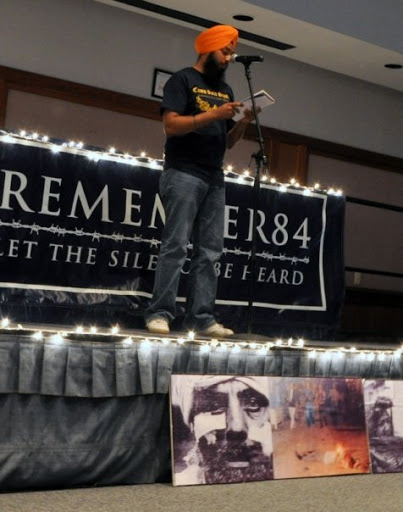
This past Saturday night, twenty artists from all over the country took to the mic in front of a packed and energetic crowd at the University of Maryland for Lahir 2009. It was a powerful evening of remembrance and reflection to commemorate the 25th anniversary of the 1984 Sikh Holocaust, organized by the DC Sikh Youth.

It was amazing to see teenagers, college students, young professionals, and even a few parents take to the stage and share their thoughts and reflections about 1984, human rights, and justice. Not only did the performers span across generations, but the performances themselves ranged in art form from musical pieces, poetry, and spoken word.

For me, it was fascinating to see how different each of the performers connected with 1984 – early in the show one artist eloquently recited an excerpt from Sirdar Kapur Singh’s 1966 speech to parliament, another tied environmental issues and water rights to 1984, while others shared personal accounts, poetry, dharmik geets, and dhadi vaaran. Regardless of how different each artist connected to 1984…the connection itself was strong…and watching that unfold on stage was absolutely breathtaking!

The evening concluded with G.N.E performing some of their recent tracks in front of their hometown audience. Seeing uncles and aunties “waving from side to side” was definitely a sight to remember.
For much of the last 25 years, Sikhs have been portrayed in a negative light around the events of 1984. We have quietly criticized the media – and while on the defensive – tried to point out inaccuracies about what actually happened…but it seemed we never really had a voice…Saturday night, that voice was heard loud and clear!

This 25th anniversary has produced several projects and initiatives that have helped document the Sikh experience of 1984, and these open mic events have also proved to be a powerful medium to document our story. I hope to see more and more of these events pop up throughout the country and abroad.
As the show came to a close Saturday night…the jakaaray kept going and the audience didn’t want to leave their seats…I kept thinking to myself, the show might be over…but the movement has only begun!
Here, here and here are some video clips of Lahir 2009…
Photos: Courtesy of Japnam Kaur