Moving The Movement…Lahir 2009

“Never doubt that a small group of thoughtful, committed citizens can change the world. Indeed, it is the only thing that ever has.”(Margaret Mead)

Last Summer, a small group of thoughtful, committed Sikh youth from the DC Metropolitan area came together to form “Lahir” (movement) – a conference organized and run by high school and college students to promote human rights awareness.

There were three themes to the event. Educate, Inspire, and Act. The “Educate” segment consisted of a series of short presentations outlining the history of post-1984 human rights violations in Punjab, based on published documentation from Ensaaf. These presentations interspersed with videos of the victim’s families told the story of grave violations that occurred between 1984-1995 during the counter-insurgency movement – including torture, disappearances, and illegal cremations. The “Inspire” segment consisted of poetry, spoken word, and musical performances along the same theme. In the final portion, titled “Act”, participants broke out in to discussion groups and brainstormed ideas on how the Punjab case can be raised to a mainstream audience and reviewing what other communities have done to highlight their cause. Overall, the conference was a resounding success and launched several new initiatives.
This Summer, the Lahir team has re-assembled and Sikh youth activists and artists from all over the country will again descend upon the Nation’s Capital for Lahir 2009! This year’s format is an all-out ‘Open Mic’ with musical performances, displayed art, poetry, and spoken word. Trailers have been circulating around the internet, providing a glimpse of what to expect.

As I’ve stated in previous posts, I feel the message and tone of our protest of 1984 has evolved little in 25 years, and as a result has yielded little return. The struggle for justice has been minimized to angry slogans and accusatory speeches…much of which has turned off so many of my generation, to a point where any time “1984″ is brought up, the inevitable “rolling of the eyes” follows.

However, a new generation has arrived! And to quote my fellow blogger Maple Leaf Sikh, “the kids are going to be alright.”
A small yet growing group of Sikh youth has emerged…with amazing creative talent and a passion for truth and justice. They have molded the stories of pain, suffering, inspiration, and courage of our last 25 years of history and crafted it into a beautiful mosaic of music, art, poetry, and film. Lahir 2009 will put such passion on display. It will surely be a memorable event…don’t miss out!

Details are as follows:

Saturday, July 18th 2009 – Doors Open @ 6PM!
University of Maryland, Shady Grove Center
9630 Gudelsky Drive, Rockville, MD 20850

There are still a few spots available for artists to perform if you’re interested, contact movethemovement@gmail.com

Ardaas – What Are The Rules?

We’ve all sat through it before…or…stood through it, that is.

As Anand Sahib ends, we stand for Ardaas and collectively reflect on the lives and accomplishments of the Gurus and the 18th century martyrs who gave their lives to preserve our Sikh way of life. Somewhere in between this reflection, and wishing for “Sarbat da Bhala”, we take a bizarre detour in to the “ins and outs” of our community.” Yes…I am referring to the lengthy list of births, birthdays, graduations, anniversaries and other milestones we find in the middle of our Ardaas.
I’m not sure when this practice started; where a member of the sangat would make an offering to the Gurdwara so an “Ardaas” can be done on their behalf. Birthdays are most common week to week, but I have heard more creative ones – celebrating a new job, new car, first mother’s day, wishing someone well on an upcoming exam, or safe travels for someone’s trip to India. Some even taken advantage of this process, by doing an “Ardaas” on behalf of their business week after week – essentially advertising their local store, while they have the entire community’s ear. I’ve raised this issue to the committee that perhaps there needs to be a better way to handle these “community announcements” rather than during Ardaas…I mean, seconds after we recount the martyrs who were cut limb by limb and scalped, we collectively thank Waheguru for Tinku’s new Benz? It just doesn’t seem right.
So what should we do an Ardaas for? What should be allowed? What rules need put be put in place? Looking at the Guru for guidance, there are many references to Ardaas, but to quote a few:

In Guru Raam Daas Patshah’s Ardaas, he asks to be in the company of those who praise/seek Naam:

thin kee sangath dhaehi prabh mai jaachik kee aradhaas
Grant me their company, God – I am a beggar; this is my prayer.

Bhagat Ravidas Ji, a cobbler and tanner who at the time was considered of low social status only had one request in his Ardaas…His darshan:

sagal bhavan kae naaeikaa eik shhin dharas dhikhaae jee 1 rehaao
O Lord of all worlds: reveal to me, even for an instant, the Blessed Vision of Your Darshan.
Guru Angad Patshah explicitly states in Asa Ki Vaar:

naanak hukam n chalee naal khasam chalai aradhaas 22
O Nanak, no one can issue commands to the Lord Master; let us offer prayers instead. 22

So what does this tell us? Should we really be doing an Ardaas for mundane issues, material things, or trivial matters?

Rather than asking for a bigger house, should we be asking for compassion instead? Rather than asking to ace an exam, should we not be asking for humility? And instead of asking for our problems to go away, should we be asking for the strength and courage to deal with our problems?

Even with such “academic” understanding of all this…in my most troubling of times, I too have asked for such mundane and worldly things in my Ardaas. Is this a measure of how little I’ve progressed on the Guru’s path? Perhaps.
But then there’s another perspective to all this…

One of the many things I love about being a Sikh is there is no priest, intermediary, or holy man that stands between me and the Guru. Although there is a community element to that Sikh-Guru relationship (through Sangat), there is also a deeply personal and individual relationship a Sikh has with the Guru…and I for one, do not like to place any restrictions on that.
I do not belong to a God-fearing religion, but instead, a God-loving religion – and I feel my Guru accepts me for who I am, with all my strengths and weaknesses. And so my dialogue with the Guru should be open, honest, and unapologetic. So if that means in my Ardaas I ask for help in achieving a personal milestone, or for a sick friend to feel better, or for a prisoner of conscience in Rwanda to be released, or offer thanks for a new car…so be it.
Furthermore, I should be able to ask anything and seek guidance for whatever question or challenge I have…as long as I’m willing to seek his Shabad for answers.

To some extent, I still feel my Ardaas is indicative of my relationship with the Guru. And perhaps through seva, simran, and reflection, that connection will become stronger, the gaps in understanding will dissipate, and my Ardaas will no longer be filled with requests, but merely an expression of what my Guru has given me…Love.

My Gurdwara’s Human Rights Committee?

Play along with me here…imagine this Sunday you walk in to your local Gurdwara – remove your shoes, wash your hands, and as you make your way to the main darbar hall, you read the notices on the wall – “Education Committee holding Kirtan Classes Wednesday Night @ 6pm.” Next to that, another sign “Cultural Committee hosts Punjabi night next Saturday!” Further along, you see “Public Affairs Committee presents Interfaith Meeting on Friday.” Then right before you enter the darbar hall, you see…
Human Rights Committee holding urgent action letter-writing workshop for two Indonesian prisoners of conscience, Sunday after Langar – and don’t forget the “Justice for Darfur” rally this Saturday morning, bus leaves at 8am Sharp!

Whoa! What kind of radical Gurdwara is this? What are the youth up to now? Is this one of those extremist Gurdwaras? Or…is it the kind of Gurdwara Guru Sahib had intended?

Guru Nanak’s mission was based on the fundamental principle of human rights. We see this not only through his Baani, but throughout significant historical events – whether it was speaking out against the caste system and refusing to the wear the janeoo or his challenge of the tyrannical ruler Babar. Even in his ninth form, Guru Tegh Bahadur gave his life speaking out for a people whose practices he disagreed with, but supported their right to practice religion freely. He gave his life for the freedom of choice and the freedom of religion. There are several amazing stories of the Guru’s activism in the area of human rights and social justice…but strangely, this subject in the context of current events has now become taboo.

The discussion of human rights in many Gurdwaras faces a lot of resistance. How did this come to be? When did it become so controversial? Where did we lose that link to our history? Rather than work out such misunderstandings through dialogue, we’ve managed to just sweep the whole topic under the rug.

However – Last week I was inspired to attend a “1984 remembrance event” at the local Gurdwara, particularly because there were more youth and young professionals there than I had seen in years. It said to me that our generation has spoken!
The time has come to bring the dialogue of human rights back to the Gurdwara…where it belongs. Rather than periodic events to mark specific occasions, I propose that every Gurdwara start its own human rights committee. Why not? Many Gurdwaras have social committees, cultural committees, and committees that have nothing to do with Sikhi – why not have a committee that is built on the very foundation of Sikhi? And let’s be clear, this would not just be a stage to highlight the case of Panjab, this committee would bring to light the cause of any and every community suffering human rights violations throughout out the world.

How would such a committee work? Rather than re-inventing the wheel, there are models out there that function well. One example is for the Gurdwara’s human rights committee to establish an Amnesty International local group. Monthly meetings could consist of urgent action letter writing campaigns, presentations on high priority cases, and attending local events. By registering your group with Amnesty International, you will receive all the materials you need for your meeting each month. The leg-work is essentially done for you and the cost is next to nothing…all you have to do is participate. You can even start your group on-line and get your activist toolkit today! There are also monthly urgent action appeals and activities designed for school-aged children, in case you want to reach out to the younger kids.

There are many Gurdwara boards out there who are begging the “youth” to get involved in the administration of the Gurdwara; perhaps this is the avenue to establish ourselves. Forming a human rights committee has several advantages – First and foremost is the benefit it will provide for prisoners of conscience and those we speak on behalf of. Secondly, it will provide an incentive for activist youth who’ve been turned away from the factional fighting and poor leadership over the years, to re-engage with the Gurdwara. And equally important, is the clear message it will send to Sikhs and non-Sikhs alike – being a Sikh is being an activist – and it is our responsibility as Sikhs to protect the human rights for any individual or community suffering. I believe that if even one Gurdwara is able to successfully launch such a committee, others will quickly follow suit. The only question is…who will be first?

A Discontinuous Journey

A few weeks back, an article called Outsourcing Prayers [scroll to the bottom], by Khushwant Singh caught my attention. It discussed how people pay big money to religious institutions abroad to carry out services and prayers on their behalf. This “outsourcing” of prayer helps out the “well-to-do” Americans and Europeans who do not have time for worship, while also benefiting cash-starved churches and the local economy of these remote areas. Several religions were mentioned in this article and Sikhs were not spared:

I sought explanation from the head granthi. He told me people from India and abroad sent money for akhand paths to be followed by Guru-ka-langar as thanksgiving or wish fulfillment. I could not comprehend how prayers recited by someone else could benefit a devotee who paid for them.

There has been much debate in our community on whether paying a professional to do an Akhand Paath on one’s behalf is contradictory to Gurmat. I also remember years ago when the SGPC was “selling” Akhand Paaths on-line. Luckily, outrage from Sikhs all over the world stopped that practice. However, this article got me thinking about Akhand Paaths, and the role it currently plays in our community.
I’ve seen various historical references to when and how Akhand Paaths began. Some say it began during Guru Gobind Singh’s time, where he had five of his Sikhs read the entire Guru Granth Sahib to him, then subsequently did so to mark significant occasions. Others say the continuous reading became prevalent while Sikhs were in the jungles and on the move. I’m not sure of the authenticity of either, but the practice itself was acknowledged by the Panth and defined in the Rehat Maryada.
There are many who debate that Akhand Paaths are simply an empty ritual and should be abolished. Most Akhand Paaths are done without anyone listening and have been minimized to a money-making transaction for Gurdwaras and Sikh institutions. While I understand and somewhat agree with this sentiment, I don’t know if I’m willing to throw out the idea altogether.
Personally, I have fond memories of Akhand Paaths at my home as a child. It seemed like the right way to mark a special occasion, and shouldn’t we be encouraging “Guru-centered” activities any way (even with our imperfections in the way we do them)? Isn’t this better than lavish parties?
Although there weren’t many listeners, I always loved going to our Guru Sahib da Kamra in the middle of the night to listen to Paath. And although I’ve only read for an Akhand Paath a few times, I enjoyed the opportunity to read Baani for an hour or two without interruption, even though my understanding was limited. It didn’t really matter to me that no one was listening.
At the same time, the Punjabi influence at our home did take over and Akhand Paaths became more about entertaining and feeding guests than the Paath itself. And as we got closer to our 48 hour deadline, my parents would nervously discuss bringing in the “professionals” to finish the Paath for us. I remember once being discouraged to participate in the later stage of the Paath, because we needed someone faster. The whole thing just didn’t seem right…
A few years ago, a handful of us (not really youth anymore) Sikh youths decided to do something different to mark one of our birthdays. Rather than our typical dinner outing, we decided to hold a Paath. Only difference was, it would be a Sehaj Paath (Sadharan Paath), or a complete but non-continuous reading of the Guru Granth Sahib. It was structured similar to an Akhand Paath in that we did follow a schedule with assigned times, but it was over a 3 week period, mostly during nights and weekends to allow for maximum sangat. We even marked on the calendar when we would be reciting certain parts of the Guru Granth Sahib that may invoke larger discussion like Sidh Gosht, Babur Baani, Asa Ki Vaar, etc. We chose one house to do the Paath in, and all took turns making meals to share the work.
It was an amazing experience and we all seemed to take something different from it. Some of the novices used the Paath as a way to improve their reading and fluency and with Sangat around following along with pothis, there was time to correct readers on their pronunciation, and re-read lines. Some of the more experienced readers paused every so often to ask for a translation of a line or a Shabad, which would often lead to discussion, and sometimes debate.
As we all gathered for the conclusion of our Paath, it was unlike any other Paath da Bhog I have attended. It took on a different meaning for me. The happiness I felt had less to do with finishing on time…but more so because I had learned something.
At the end of the day, I don’t feel Akhand Paaths should be abolished or anyone should be discouraged from reading Baani, continuously or not – but, I do hope our generation does organize, participate in, and encourage more Sehaj Paaths. I believe this will be more educational and experiential for all involved. And following the “State of the Panth” through camps and several different blogs for some time…it seems like such individual and community reflection is needed now more than ever.
In Sikhi, we have powerful and beautiful traditions, I hope the inquisitive nature of our generation will force us to bring more meaning back to such traditions, rather than just empty ritual…which is what I believe, Guru Sahib had intended.

On Common Ground

Years ago, I attended a Sikh retreat far from home – outside of the United States and outside of my “normal crowd.” It was interesting to experience Sikh life in a different country…and I think Bono had it right when he said, “We are one, but we’re not the same.”

The first morning we all woke up at Amrit Vela and joined in Nit-Nem and Shabad Keertan. Everybody was in to it and nobody seemed distracted. It was one of those powerful “Sangat” experiences where you lose yourself and become part of the whole. I loved it! I was so energized after that Deevan and was excited for all the weekend’s activities to come…then came breakfast. It was a little chaotic as we entered the dining hall. Although the meals were vegetarian (God help us if they weren’t), a group of Singhs were arguing with the aunties demanding to see the packaging for the bread. They were convinced that this particular brand of bread had an animal byproduct as an ingredient. I skipped the bread and quickly moved pass, but finding a place to sit became an ordeal in itself. Although there were at least 50 people at the retreat, less than half were eating in the dining hall. I looked around and saw a handful of Singhs back in the kitchen sitting together eating from Sarab Loh bowls, cups, and plates. Another group of Singhs were heading back to their dorms to eat the food they brought, as their maryada only permitted them to eat food prepared by other Amritdharis who followed their same maryada. As for me, I felt like the new kid walking in the cafeteria on the first day of school trying to figure out which group I could fit in to. What happened to that warm and fuzzy feeling I had sitting in the Deevan? Now this Sangat, who couldn’t share a meal together, felt cold and distant.

Turns out mealtime wasn’t the only time we found ourselves at odds. We spent much of the weekend arguing over how many Baanis one should read daily, or whether Raag Mala is Baani, or the authenticity of Dasam Granth, or whether Keertan should only be sung in Raag. We even debated over what colors should be prohibited for Sikhs to wear. Considering I grew up in a Sikh community that still argues over whether keeping “Kesh” is necessary, this was all quite a culture shock. The whole experience was difficult for me to swallow.

I thought to myself…with all the challenges we as a community face in the real world, it is disheartening to see how disjointed and fragile we really are. If we can’t agree on some of the most basic of Sikh principles and practices, how can we really progress as a community?

Mid-way though the retreat, I became frustrated. I mentally checked out and just waited for the whole thing to end.

However – on the last morning, one of my dorm-mates, who I spent much of the weekend arguing with, arose at Amrit Vela to wash his hair and begin his Nit-Nem. He must’ve done this every day, but on this particular morning, it woke me up. Although we both criticized each other’s maryada, I was impressed with his discipline and moved by the way he personally connected with the Guru in this way. And then it dawned on me,

“Who am I to judge or criticize, when he is up at Amrit Vela engrossed in Simran and I am lazily lying in bed.”

There is, after all, one thing we do have in common – and that is the love for our Guru. But our Sangat, experiences, and influence are different. Therefore, there are differences in the way we practice. The way we practice is tightly aligned with our belief, and belief is not something we take lightly. Most are unlikely to change. But does this mean we have to settle for Panthic disunity?

Perhaps.

But I ask, have we ever really been united as a Panth? Only a handful of historical events come to mind where Sikhs from various groups had set aside their differences and shared a common goal – Banda Singh Bahadur’s conquer of Sirhind, and the immediate days after the 1984 Darbar Sahib attack come to mind, but for much of our history, there has been such disparity – even during the Guru’s time. It did not seem to prevent the Gurus from accomplishing their mission, so why should it prevent us?

There are some groups of Sikhs I disagree with, but they do the most amazing Keertan that touches my soul. There are some groups of Sikhs I am critical of, but I envy their sense of discipline. There are some groups of Sikhs I don’t see eye to eye with, but their passion for activism and social justice is inspiring. There are some groups of Sikhs I question, but their preservation of our sacred martial arts and warrior tradition is remarkable. So it begs the question…is it possible for us as Sikhs to embrace our commonalities and dare I say, “learn” from each other’s influences, yet be mature enough to accept each other’s differences…and agree to disagree?

Rather than spending our energy challenging one another over maryada and being critical of each other’s practices…can we instead focus that energy on living up to our own maryada and bettering our self? I, for one, have long ways to go.

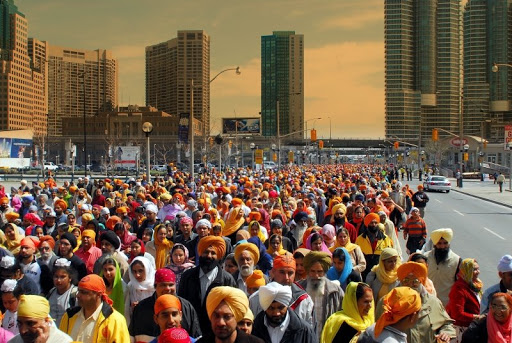
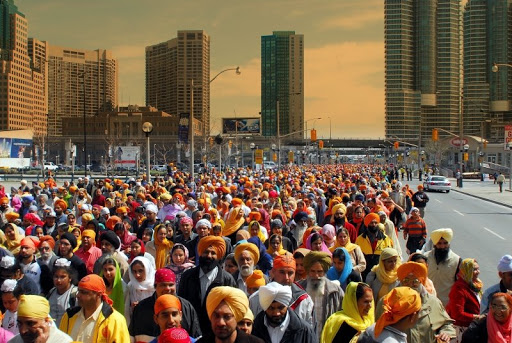
I guess I’m starting to see the glass half-full. At this year’s Nagar Keertan, I passed by several aunties and uncles complaining of how chaotic the event was and how disorganized we were. But what I saw were thousands of my brothers and sisters…in different clothes, speaking different languages, some from different cultures, and even with slightly different practices…all marching the same direction. And I can’t help but wonder…rather than fight over our differences, is it possible we can rise above…and celebrate the beauty in our diversity?

On The Shoulders Of Giants

Recently published on sikhchic.com

My father always kept a large collection of “Sikh” books at home, covering all aspects of Sikhi – history, Gurbani, and contemporary issues. I rarely delved in to these books, because the English was so hard to understand – often written by authors from the early 1900’s or non-English speakers. But on a hot summer day, while on break – one book caught my eye.

It was a series of essays – easy to read, easy to understand…and most of all…captivating! I read the entire book in one sitting. I was able to relate to it so well, as it spoke about Sikh history’s significance in today’s society. One essay, titled “What Is A Head Worth” blew me away. Although I heard the story of Vaisakhi Day in 1699 dozens of times, this essay brought it to life for me, and I connected with it in a way I hadn’t before. More importantly, the author made it relevant to today…and relevant to me. He explained that 300 years later, the Guru is still asking for our head. And we are being tested every day by our choices and actions the same way Guru Sahib tested his Sikhs on that day. The author concluded the essay with a question that shook me, and I immediately wrote it in my journal.

Three hundred years later, once again the Guru wants your head. Many will slip away, just as they did three hundred years ago. Many more will look away, just as they did then. The question is: How are you going to answer the call?

I was so moved by this book, I did something I never did before…I wrote a letter to the author. This was long before email and commenting on blog posts…this was a hand-written note. I wanted to tell the author how much I loved the book and how much this essay meant to me as a young Sikh discovering my faith. To my surprise, a few weeks later…I received a call.

Sure enough, it was the author. He was appreciative of my note and we engaged in discussion. I couldn’t believe a professor and published author would take the time to call me…a mere college freshman. I invited him to speak at a conference a few of us university students were organizing and he obliged. The conference was a disappointment, as it turned out most of the participants were more interested in partying than attending the workshops – very few actually attended his talk. But he gracefully understood and encouraged me not to get frustrated and continue organizing such events…so I did.

As years passed, the author and I lost touch, but we would run in to each other from time to time in various cities – at workshops, retreats, seminars. He was always a featured speaker and it didn’t matter what the topic or theme was – he was always an expert. And each time we would meet, he would mention the letter I sent him as a kid – and remind me that he still keeps it!

I have followed his writings over the years, through his books and his articles on sikhchic.com, and they still captivate me. Often times he titles them with something provocative, as though he may make some controversial declarative statement at the end – but he rarely does, sometimes to my frustration. He instead raises pertinent issues, analyzes both sides of the argument down to the intricate details – and then leaves the reader to make up their own mind. As I’ve gotten older, I’ve learned to appreciate this more. As I’ve seen in Sikh politics and Sikh leadership, we often rush to make declarative statements without the necessary discourse and debate. And we become more comfortable just following the “loudest talker” rather than thinking for ourselves.

Late last year, on a whim – I sent an essay of my own to the author for his feedback. I respect him as a writer and was hoping to develop my own writing. I had rarely shared my essays with anyone else before. He promptly replied with some feedback and encouragement. He also suggested I send my essay to sikhchic.com. With that encouragement, I’ve continued to write and share pieces – which has been a tremendously reflectively experience and one where I’ve discovered a lot about myself in the process. It’s funny, that same person who patted me on the back and encouraged me then as a kid, is still doing the same 15 years later.

I thank Dr. IJ Singh (UncleJi) not only for his guidance and encouragement of me, but for his guidance and encouragement of so many Sikhs of my generation. Although he is a self-proclaimed “gray-beard”, he has a knack for connecting with youth activists unlike any other, serving as a trusted mentor and advisor to several Sikh organizations. He has filled the gap as a “visionary” and “thinker” for our institutions, something we as a community often lack.

In one of UncleJi’s previous columns, “From Seeds To Flowers”, he poignantly addressed the youth of today, stating, “Sometimes I like to tell them to keep in mind that if they can see farther and act more purposefully, it is because the young stand on the shoulders of giants.”

True indeed! I wish UncleJi the best of health, the highest spirits…and most importantly…the strongest of shoulders!


Are We Expecting Too Much?

History tells us that Guru Nanak Patshah created Dharmshalas in Kartarpur where Sikhs would rise early and meet for Keertan, Veechar, reflection, and Guru-ka-Langar. It was a central element to the ideal society that Kartarpur would become. Over a century ago, Sikhs first arrived in North America – working at lumber mills, railroads, and as migrant laborers. They settled their families and chose to establish Gurdwaras (as early as 1908 in West Vancouver, BC and 1912 in Stockton, CA) to preserve both their spiritual and cultural roots in the land far from their history.

Now with hundreds of thousands of Sikhs in North America and the needs of our communities growing, the Gurdwara has expanded the services it offers far beyond its humble beginnings. Many Gurdwaras have Khalsa schools and libraries. Others plan for fitness centers, basketball courts, and healthcare clinics. One of the local Gurdwaras here hosts an annual Panjabi cultural show and mela, with weekly Giddha and Bhangra practices held at the Gurdwara facility itself. The North American Gurdwara has become not only a spiritual center, but also a community center, serving all the needs of the Sikh and Panjabi population.

On the one hand, I like having a Gurdwara as the center for our community’s activity. Although not all people have an initial interest in Sikhi, all these other events and programs at least keep people coming. And even a short “ritualistic” trip to the Gurdwara could develop in to something more. On the other hand, I can’t help but wonder…are we asking too much from our Gurdwaras?

With such different and competing interests, leaders fight for position so they can make their agenda the focus, and control Gurdwara resources accordingly. This drives much of the political drama and power struggles that surround our Gurdwaras today. As a result, many programs (such as Khalsa schools) end up mismanaged, poorly resourced, and inefficient. Secondly, with all the programs our Gurdwaras offer, I question – are we taking away from the primary purpose of the Gurdwara…learning Gurmat (the Guru’s way)? How well do our Gurdwaras focus on Simran and Veechar? How well do our Gurdwaras connect the youth with the Guru’s message? What about services for non-Panjabi speakers or introducing non-Sikhs to our faith? What about programs emphasizing Sikh culture – like Gatka or Gurmat Sangeet? Are our Gurdwaras really institutions for learning? If the answer is less than perfect, shouldn’t we re-prioritize and change the focus of our Gurdwaras?

Many Gurdwaras serve small communities in rural areas where limited resources force the Gurdwara to serve multiple purposes. However, in larger communities, where resources are plenty – should we consider separating out our organizations? Maybe create separate Punjabi societies, Khalsa schools, clinics, and even Sikh community centers that focuses on outreach, youth counseling, and seva projects? Perhaps under separate structures and management, these organizations will be able to thrive and meet their goals more efficiently with less resistance. And with our community’s growing needs, why not grow our presence with more diverse organizations?

Thoughts?

Faith and "I"

Good Morning.

I will be taking care of all your problems today.
So sit back, relax, and enjoy the rest of your day!
-God

This is what the sign on the wall read at the Salvation Army on the North side of Chicago. Prior to volunteering there, I only knew stereotypes of the homeless and hungry…just what you see on TV. But it didn’t take long for those stereotypes to break down. The people we served meals to were happy, smiling, polite and full of energy. What surprised me most, was their deep sense of spirituality. Not only did I find this in my conversation with folks, but even in their greeting. My standard, “Good morning, how are you?” was often replied with “Blessed” or “In His Grace”, many with bible in hand.
I used to wonder, how could people so hard on their luck, have so much faith? I have seen so many times with family and friends, after they’ve suffered difficult circumstances or loss, God and religion are the first things questioned, i.e. “How could God do this to me?”
I’ve been reflecting quite a bit on “faith” lately, as I’ve noticed a growing pattern of Sikh Youth beginning to doubt their belief in God. In my conversations with some of these youth (many of whom come from wealthy backgrounds), I’ve tried backing off the subject of God altogether, and simply asking – “What do you believe in?” And it’s been pretty consistent. Most of their belief lies in achieving materialistic and financial goals – a high-paying job, big house, nice car, admiration and respect from the community etc. I would listen to this in awe, thinking to myself, that’s it? There is nothing else? Nothing deeper?
I’m not implying that poor people are more inclined to be spiritual or more likely to believe, while the wealthy are incapable of it – of course, all of us can think of examples to prove that theory wrong.
But in simplest terms – in order to believe in God, you must first believe that there is something bigger than yourself.

And therein lies the problem…

I wonder…is their doubt really based on any atheist philosophy or scientific theory, or it is just Haumai (I-am-ness). Is it our Haumai that convinces us that we know everything when we really don’t? Is it our Haumai that inhibits us from connecting with the Shabad? Is it our Haumai that prevents us from believing?
In page 346 of Sri Guru Granth Sahib Ji, Bhagat Ravidas Ji says:

malin bhee math maadhhavaa thaeree gath lakhee n jaae
My intellect is polluted; I cannot understand Your state, O Lord.

karahu kirapaa bhram chookee mai sumath dhaehu samajhaae
Take pity on me, dispel my doubts, and teach me true wisdom.

I believe Waheguru is within everyone, believer and non-believer alike. But the force that connects us to that Waheguru within can be strong, weak, or non-existent depending on our Haumai. A friend once compared this to metal filings and a magnet. If you put a stack of papers in between the two and move the magnet, the filings will only move a bit – if at all. But as you remove the layers of paper, the filings will eventually move the direction of the magnet. And as the layers become less, the force between the magnet and filings become so strong…they will eventually be in sync. Similarly, we must remove the layers of Haumai to be connected with Him.

Thoughts…opinions? I’d love to hear.

Let The Truth Be Heard

Earlier this month, worldwide Human Rights organization Amnesty International released a news article on the plight of Sikh Massacre victims of 1984, still awaiting justice after 25 years. This came shortly after the Delhi Court delayed ruling on Jagdish Tytler, due to the CBI’s inability to produce enough evidence against him. Ramesh Gopalakrishnan, Amnesty International’s South Asia Researcher stated:

“The fact that almost 3,000 people can be murdered without anyone being brought to justice is offensive to any notion of justice and should be an embarrassment to the Indian government.”

“For the Indian government to dismiss these cases due to lack of evidence is farcical. The various agencies responsible for carrying out the investigations failed to carry out the most cursory of tasks – including recording eyewitness and survivor statements.”

As troubling as it is to read this, I was pleased to find that Amnesty International had covered it at all. As many of know, AI, as well as other independent human rights groups and initiatives were either banned or prevented from conducting research in India in the late 1980’s and early 1990’s. It seems as though there is hope for an independent investigation on the 1984 anti-Sikh pogroms and perhaps the subsequent disappearances during the counter-insurgency.

Not so fast…in an un-related story, the Tribune reported that Amnesty International has decided to shut down its India operations. The decision is said to have been triggered by continued denial to the Amnesty International Foundation of the FCRA (Foreign Contribution Regulation Act) registration by the Government of India. In a letter to the country offices Amnesty International said,

“The Government of India continues to deny the FCRA registration to the AI India Foundation and our local resources are very insufficient for our survival.”

You might ask – with a corrupt government, poor human rights record, rejection of independent investigations, rejection of the ICC, and an unbelievably strong lobby – what course of actions must Sikhs take for justice? I don’t know… But I do feel our generation has a unique opportunity to present our case to the world in a way the previous generation could not. The material is out there…AI Reports, HRW reports, Ensaaf reports, and personal accounts – but it’s upon us to either let this information lay on shelves collecting dust in law libraries…or to make it known to the world. Let this 25th anniversary of the Sikh Holocaust serve as a call to artists, musicians, film-makers, MCs, poets, writers, educators and story-tellers…the Panth needs you…let the truth be heard!


A Moment Of Pause

In my desire to churn out thoughts as quickly as possible, I came across this audio essay that gave me a moment of pause. I think this is a good reminder for all of us – bloggers, writers, poets, MCs, and other story-tellers, why we do it…and how we can be better.

It’s a 5 minute piece from my favorite series, “This I Believe” in their final episode on NPR titled, “Life Is An Act Of Literary Creation.” It’s definitely worth a listen. After all, how can you turn down a piece that starts off with “I believe God is a poet.” I mean, really?

Enjoy!