
Category Archives: Uncategorized

2084 & I

A few weekends ago, I had the opportunity to attend Saanjh.

Saanjh is a Bay Area based NGO, that has been running community focused events for the last 4 years. One of their main initiatives, the Saanjh Leadership Retreat, explores subjects like an individual’s personal relationship with the Divine, identity and culture issues, history, literature and present day challenges before the panth. This Memorial Day weekend, they brought Saanjh to the East Coast.

I’ll admit, I was a bit apprehensive to attend at first. It’s been a while since I’ve attended a conference or retreat. Over the last several years, I’ve mostly volunteered at gurmat camps for children and teenagers. And at such camps, the expectations are pretty standard. Let’s face it…you can only accomplish so much with one week a year. Kids are mostly influenced by their parents, their home environment and their peers. So the week in the woods is mostly a “re-charge” to be with sangat, hang out with friends with similar experiences and have a fun, spirited time…and if you learn something about gurmat or history along the way, it’s an added bonus.

Retreats attract a slightly older crowd, mostly young professionals. And with that level of education, maturity, and advanced skill sets, I wonder…shouldn’t we expect more than we do of our camps? In my opinion, the Sikh nation currently faces way too many challenges for us not to. When I attended retreats in my college years, I learned a lot about the issues facing the panth, but rarely did the experiences at the retreats carry over to any meaningful panthic work after it was over. Most of the retreats focused on gurmat, history, and social issues, but only a few hours on the last day for specific project work. And during that time, projects are quickly thrown together with a lot of spirit and enthusiasm, email addresses are exchanged, and a few weeks later…nothing. I’m sure some of you reading this have been the one sending that first post-retreat email to your project group and after no response think to yourself, where did all that spirit go? I know I have, so I wondered…was I to expect the same of Saanjh?

The theme of the retreat was ’2084’ – where we asked ourselves, where do we see the Sikh nation in the year 2084? What institutions do we hope to leave our grandchildren and great-grandchildren? From this ‘2084’ mission, we discussed goals, milestones, specific projects and the capital required (social, financial, human) to make such goals a reality. This 2084 institution-building theme led to lively discussion throughout the whole weekend while gurmat, history, and gurmat sangeet were interspersed. But does this approach really work?

Surprisingly, although Saanjh is only in its 4th year, it has already established several significant initiatives. Some projects are organic, like the Saanjh Scholarship, which aims to award $20,000 this year to students based on merit and financial need. Other projects like ‘Adopt A Family’ are strategic partnerships with established organizations like Baba Nanak Educational Society (BNES), which provides aid to families of farmer suicides in Punjab. The Saanjh community aims to spread awareness on the issue of farmer suicide and serve as a fundraising vehicle for the amazing work BNES is doing. Other projects getting off the ground are a “living history” that documents individual’s experiences around 1984, and a gurbani veechar resources initiative.

I believe much of Saanjh’s success has to do with limiting the scope and focusing on making few projects successful, rather than constantly inventing new ones. Another important factor is having a dedicated group of volunteers who help provide infrastructure and resources to the projects to ensure they keep moving in between the retreats. Sure, only time will tell which projects stick and which do not, but from what I’ve seen, the ones that stick have a good chance of becoming long-lasting institutions to benefit our community for decades to come.

At the retreat, some of the activities focused on personal development and discipline, while others focused on building institutions and moving the panth forward. Now that I’ve had a few weeks to connect the dots, Saanjh reminded me that as Sikhs we have so much to offer the world – look at our role models – Guru Sahib built cities, brought in commerce, organized communities, helped the under-served and advocated for social justice all while maintaining a connection with the Divine. And if I intend to a be vehicle of Guru Nanak‘s philosophy, if I intend to be his ‘sevak’, then I too must strengthen that bond and cultivate my relationship with the Guru.

Thanks Saanjh for the sangat, inspiration, and for reminding me of this important lesson!

The next Saanjh retreat will be held on October 18th – 21st in Santa Cruz, CA.

If you’d like to donate to any of the Saanjh initiatives, please visit http://www.saanjh.org/donate

It Must Be Basant

It must be Basant

I know…a Shabad reminded me so
And thank God for that, or else I never would have known

When I look outside, there’s no Basant. It doesn’t feel like Spring
It is cold…frigid even. There is no blossoming, no blooming, no rejuvenation, no growth
When I look inside, deep within my soul, there is no Basant either
It is cold…frigid even. There is no blossoming, no blooming, no rejuvenation, no growth

But I fear not

For my Guru shakes me out of my malaise, and says to me “Bholiya!” (Ignorant One)
Haumai Surat Visaar” (Let go of your egotistical intellect)

He tells me to check my ego, reflect on His name, and absorb the virtues of the divine

Then…a warmth comes over me

And for a split second, I find myself lying under a tree.
A tree made up of my deeds,
With branches made of Simran
Upon this tree grows fruits of knowledge and flowers of discipline
Leaves are made of awareness
And my egoless mind shades me from the sun
A beautiful Spring day, a warm breeze touches my face, a silence so deep…all I hear is the vibration of His name

And in a moment…it all disappears

When I am filled with hurt and sadness, all I can offer the world is hurt and sadness
When I am filled with Basant, all I can offer the world is love

SatGuru, grant me this wish –

Please let my Basant last forever…

Inspired by Guru Nanak Sahib’s experience:

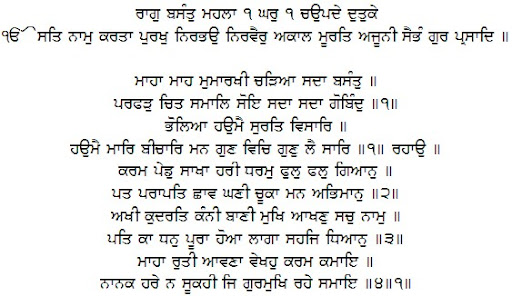
Among the months, blessed is this month, when spring always comes.
Blossom forth, O my consciousness, contemplating the Lord of the Universe, forever and ever.
O ignorant one, forget your egotistical intellect.
Subdue your ego, and contemplate Him in your mind; gather in the virtues of the Sublime, Virtuous Lord. Pause.
Karma is the tree, the Lord’s Name the branches, Dharmic faith the flowers, and spiritual wisdom the fruit.
Realization of the Lord are the leaves, and eradication of the pride of the mind is the shade.
Whoever sees the Lord’s Creative Power with his eyes, and hears the Guru’s Bani with his ears, and utters the True Name with his mouth, attains the perfect wealth of honor, and intuitively focuses his meditation on the Lord. 
The months and the seasons come; see, and do your deeds.
O Nanak, those Gurmukhs who remain merged in the Lord do not wither away; they remain green forever.
Please take a moment to reflect on Guru’s Sahib’s experience in Raag Basant.  Keertan seva by Bhai Avtar Singh 

Who Are You To Judge?

As a teenager, most of my summers were spent in the gym, along with my friends, as we geared up for our upcoming Fall sports. When running and lifting weights, I always found my dastaar to be uncomfortable, so I would opt for a modified patka with a baseball cap on top. Now, before I get arrested by the panthic police, let me explain that this was not an uncommon practice (right or wrong) back then by many Sikh boys on the East Coast to wear bandanas or baseball caps during sports. Even after I moved to the Midwest after college, I carried the same look to the gym for my evening workouts.

After one of my workouts – baseball cap and all, I recall making a quick stop at the post office to drop off a package. While waiting in a long line, from the corner of my eye I saw a Sikh man standing way at the back near the exit. As I dropped off my package and headed out, I caught a better glimpse of the Singh. He was middle-aged, wore a flawless dastaar and had a long flowing beard. Although I never felt I was doing anything “wrong” with my workout attire before, I immediately felt uncomfortable and perhaps a little embarrassed. I quickly walked out, only making the slightest eye contact with him.

Weeks later while at the Gurdwara Sahib, enjoying my langar quietly and alone – as many bachelors in an unfamiliar city could appreciate – a familiar looking Singh in a kurta pajama sat next to me. After a quick greeting, it occurred to me it was the same gentleman from the post office. He introduced himself and shared a bit about his family and three children. He asked me about my work and we had a pleasant conversation. About half way through our talk, he brought up the incident at the post office and confirmed that it was in fact me wearing the baseball cap. I explained that it was only for the gym, but he didn’t seem to care too much. As we ate our langar together, he shared with me what it meant for him to wear his kakaars and how proud he feels to wear the Guru’s bana, regardless of where he is or what activity he’s doing. He had a labor intensive job, and said it wasn’t always easy to keep his dastaar, but he felt he owed it to the Singhs of the past, who gave their lives for us to stand proudly with our kesh and dastaars, to wear them at all times. He also said his children get excited when they see another Sikh at the mall or a restaurant, whether they are wearing a parna, dumalla, or the traditional Patiala style – it gives them a sense of pride – and that part of our tradition should never be replaced by a bandana or baseball cap. I didn’t say much…but listened closely. After about 15 minutes, he gracefully apologized for taking too much of my time and hoped that I had not felt uncomfortable with bringing up the topic. We then parted ways.

For the next few days, I thought about what he said and from that day forward I never wore a baseball cap again. Turns out, a parna is way more secure and comfortable than anything I’ve worn for a sport…and well, I know a 100 year-old marathon runner who can tell you a full dastaar would do just fine too 🙂

Now my little secret…this post isn’t really about Sikhs wearing baseball caps.

What may seem like a typical langar conversation between two strangers may not be so common after all. I can think of dozens of times in my community (and sometimes my family), where a person is criticized, judged, or slandered for doing something or looking a way that does not match with their perspective of Gurmat – all without the person in question present. Now in our highly socially-networked society, the criticism of the kid wearing the baseball cap, sporting the trimmed beard, the girl with trimmed bangs, or “did you see what she was wearing?” hits a facebook status quickly – it now spans a much wider audience in a much shorter time. So what was different about my situation at the Gurdwara?

Rather than making an episode of it, he chose to quietly approach me, engage with me, and share his thoughts in a gentle way. I could have easily been offended…who the heck does this guy think he is? He doesn’t know anything about me – my personal discipline, how spiritual I might be, how much seva I might do…just because he dresses the way he does, he thinks he’s a sant?

But none of that crossed my mind.

I guess something magical happens when someone approaches you with genuine humility.  Sometimes, just sometimes…it makes you humble too. And humility can make you do wonderful things – pause, reflect, open your mind, and well…change.

Often times we shun criticism directed toward us, because after all, “who are they to judge?” and the automatic follow-up, “Sikhs are not supposed to be judgmental.” Is that so true? Sure, gurbani tells us to look within ourselves and change, but what role is sangat supposed to play? Aren’t we supposed to be honest with those in our sangat, help “pull each other up” and keep each other moving toward the Guru?

The Singh was right, and deep down I knew he was right or I never would have felt uncomfortable that day in the post office when I saw him. In years recent, I’ve tried to have that gentle one-on-one conversation like the Singh had me with me during langar. Whether it was a former student of mine who recently trimmed their beard or a childhood friend who started drinking…unfortunately, I haven’t been too effective. Perhaps they weren’t able to dim their ego long enough to open their mind…or perhaps my ego was shining too bright.

Clearly, it’s the approach that makes the difference. As we learned in the janamsakhis, Guru Nanak Sahib transformed the most villainous of criminals to change their ways and follow his path – I wonder – what was it? Was it his logic and reasoning alone? Perhaps…but I believe it was also his love, his empathy, and the compassion in which he expressed it.

So I need to reach a more genuine state of humility before I offer guidance and also the same to receive it. I have plenty of people around me to point out my flaws and weaknesses, people I love and respect, people who want me to be a better person, and a better Sikh. But I can’t think of many times I’ve controlled my ego long enough to truly listen. And if I only did, like that time at the Gurdwara, who knows what might be possible?

So for now, I will try to stay armed and ready…


Humility is my spiked club
My dagger is to be the dust of all men’s feet
 No evil-doer can withstand these weapons
(Guru Arjan Sahib, Raag Sorath, SGGS pg. 628)

Wisdom To Know The Difference

Remember quote books?  If not, these were the books that poetry nerds like me used to have many years ago, so we could document all our favorite quotations. I once received a quote book as a gift which on the front had Niebuhr’s serenity prayer:

God grant me the serenity
to accept the things I cannot change;
courage to change the things I can;
and wisdom to know the difference.

With all the quotations I captured over the years in my book, it was actually the one printed on the front that stuck with me the most. And I would realize different aspects of this prayer at various times throughout my life.

For me, the easiest to understand was the “courage to change the things I can”…in theory at least. Being a Sikh, I feel this is something I’ve learned early on. Gurbani reveals the traits, personality, and thinking of a gurmukh. I have always found myself distant from this ideal, so there is always work to do and progress to make. It’s almost hard to be complacent. If I am truly a student, I need to always be reflecting, learning, and finding ways to improve myself in order to move closer to the Guru.

Accepting the things I cannot change” hasn’t been quite as easy. Especially as I’ve gotten older and experienced more hardship and loss. I’m constantly in battle with my ego and attachment, and although Guru Sahib gives me the tools to overcome this, to rise above the five vices and accept his hukam…I still struggle.

The “wisdom to know the difference” has really just been an afterthought.  Frankly speaking, the categories of things I can change and cannot change have always been pretty black and white to me – so why the need for wisdom to know the difference?

I recently heard an audio essay titled ‘The Serenity To Change The Things I Can’ by Mark Olmstead from my favorite NPR series, “This I Believe” that challenged my beliefs and made me re-think the importance of “knowing the difference”, especially in my relationship with gurmat.

Often times when having gurmat-related discussions, with friends, at camp, or during gurbani veechar, I often find myself reflecting on the virtues of a gurmukh, not just the personal discipline but more so the internal qualities – compassion, humility, forgiveness, acceptance of hukam, seeing Waheguru in everyone etc. and conclude thinking to myself, ”Yup, it’s hard to reach that stage” and without even thinking about it, quietly tuck that away in my “accept the things I cannot change” category. It’s becomes easy for me to say, “Yeah, I’m just not there yet” and be content with that.  It’s almost as though as long as I’m being honest with my weaknesses, it makes it okay.

That charade may work for a while, but it surely doesn’t when you have children. If I want to be a role model for my children, then I need to “walk the talk.” Although other adults may sympathize with my weaknesses – my kids, however, are not interested in my excuses. And do I really want to be that parent who has to constantly make excuses for himself, anyway?

In Olmstead’s essay, he accepted the fact he had to live in a litter-filled community…until he found the courage to create change, and by doing so, started to question what other things were possible. He states, “You can’t assume to know the difference between the things you must accept and the things that you can change—you have to think about it” – I couldn’t agree more.

So perhaps I need to re-examine the things I’ve long accepted as “things I cannot change”, and create some tangible goals for myself. Not everything might be possible right away, but something has to be. I take comfort in knowing that I am not alone in my challenge – my family and sangat are there to help me. As my wife and I recently discussed, sangat is not just people you listen to kirtan with, they are the people who inspire and encourage you on your path to the Guru…and perhaps, should hold you accountable toward your goals.

Such ruminations on change, acceptance, and well…litter, made me think of a story a friend recently shared. As a teenager in Amritsar, my friend would often run in to Bhagat Puran Singh. Sometimes he and his friends would join the legendary gursikh on his evening walks. During one of the walks, he noticed that Bhagat Ji would stop to pick up trash off the road and put it in his pocket. He would continually pick up trash throughout the course of the walk. Finally my friend asked, “BhagatJi, no matter how much trash you pick up, you will never clean all of Amritsar.” BhagatJi lovingly replied, “When it’s time for me to face my Master, he will not ask whether I’ve cleaned all of Amritsar…but he will ask whether I’ve cleaned my path


How Bad Do You Want It?

A few months back, I wrote a post about ‘Pyaas’ (Thirst).

The argument I made was that above and beyond our external uniform, our personal discipline, and panthic responsibility – there is something else that is essential in the life of a Sikh…that desire or yearning to be with the Beloved.

In discussing this topic at a few different Gurmat camps this summer I shared a story I read about two Zen Bhuddist Monks, and how the younger/junior monk asks the wiser/senior monk, “how do I reach enlightenment?” Turns out the story is a pretty universal, as I stumbled upon it in a slightly different context in the video below. In the video, the student asks his Guru “how do I become successful?”

Being a football fan and having a terrible habit of explaining things through sports analogies. this video really appealed to me. At the end of the day, anybody can put on a uniform, but only few can live up to what that unform respresents…only few will achieve greatness.

Living the life on the Guru’s path can be challenging…battling your own ego, jealousy, and anger can often feel like sprinting up hills. But imagine what it must feel like to stand above it all?

Whether it’s an athlete reaching his goal, a businessman achieving “success”, or a Sikh trying to connect with her Guru…the question still remains…“How Bad Do You Want It?”

.


No Kaur Left Behind

Shortly after a recent blog post, a few parents and I were discussing our experiences presenting Sikhi at our children’s school. One parent had an extremely positive experience when a Sikh Coalition presenter came to speak at her daughter’s elementary school. So much so, the presenter was asked to come back and speak to some of the other grades.

In hearing about this, I asked my friend’s 9-year old daughter what she liked about the presentation; she was particularly excited to show her kara to everybody and her long hair at the appropriate times. I then asked her, “How did it make you feel after the presentation was over?” She replied with something that stuck with me, “I felt so special…I wanted to cry.”

As a child, I dreaded the first day of school. Not just because of the anxiety of being around new teachers and students, but that was usually the day my Dad accompanied me and would explain to my teacher in his quick three minute speech who Sikhs are and what I was wearing on my head. Some teachers were not quite sure what to do with this information, while others were very engaging and would share what they learned with the class.

As difficult as it was to get through that introduction, it did come with a sense of relief, not only for that day but for the whole year. At that moment, everybody knew I was different, everybody knew I followed a religion that required a certain discipline. And because of that, I looked different…that was it! After that, people could befriend me, dislike me, or ignore me as they so chose – I really didn’t care. No matter how hard I could’ve tried, I would never look like the other kids, being different was something I simply had to accept. And years later, it was something I grew to love.

So many of my friends throughout my school years struggled to find their identity and develop their sense of individuality, with my Sikhi – I didn’t even have to try! I believe these experiences over time have helped develop my self-confidence, and those few awkward moments every year where my father would educate my teacher played an important role in that.

My sister and I were raised with the same Sikh values at home – but my parents never visited her classes, nor did they ever feel a need to explain to her teachers or other students that she was a Sikh. And why should they? Let’s be honest…those three minute talks with my teachers were not to promote Sikh Awareness, it was simply to convey enough understanding so I wouldn’t get bullied and want to come home and cut my hair.

It wasn’t just my sister who missed out on that opportunity, but I would guess most girls in our community did not have that same “special handling” as so many of the boys did. I wonder what teachable moments were missed? What life lessons could’ve been learned? Sure, we all have struggles to overcome during our adolescence that help build character – it does need to be because of our faith or identity. But I feel the boys of our community get that extra support and encouragement by default, whereas the girls are often overlooked.

As you can imagine, there are broader issues here, much of which goes back to the double-standards we see in our communities every day. Young boys are praised and encouraged to wear a dastaar, but what about young girls? How many dastaar bandhis for Sikh girls/women have you attended? When a boy cuts his hair, the whole community is vigilant, asking “what should we do about the boys?” but a Sikh girl cutting her hair goes unnoticed. We all praise young children (boys and girls alike), when they reach milestones on their Sikhi – learn a new Shabad, memorize their paath, etc, – but how many of us encourage the teenage girl who’s aspiring to take Amrit?

Last month, many of us read a fascinating article by Lisa Bloom about the traditional way we speak to young girls and how it sends all the wrong messages. It made me wonder if we need to re-think the way we talk to our little Kaurs. Even amongst our daughter’s Sikh friends, we are quick to compliment their clothing or ask about their hobbies and TV shows, but I rarely ask how many pauris of JapJi Sahib they’ve memorized or ask them the meaning of the shabad they just sang (or explain it to them if they don’t know it), nor have I asked any of the older ones how far along they are on their practice for Charni Lagna. Perhaps the way I interact with these young Kaurs needs to change

To be clear, I applaud how our community supports and encourages our young Singhs, but I must ask…how can we carry on that type of empowerment to our Kaurs?

At a local camp this past week, a teacher reflected about a dialogue that took place in one of his classes. In discussing the Char Sahibzadey, one student noted that Guru Gobind Singh had four sons, but did not have any daughters, but then an 8 year old girl stood up and said “That’s not true…he has me!”

This is what I want every Kaur to feel…the sense of pride, history, and love that only the daughter of a King could feel.


Out Of Service?

Over the long weekend, I had the good fortune to attend a Gurmat retreat out in the Midwest.

The theme for the retreat was the Rehat Maryada and I thoroughly enjoyed spending an entire weekend in workshops that delved in to the various components of the Maryada, like Gurmat Rehini (Living in Gurmat), Shaksi Rehni (Personal Living), Guru Panth, and Seva.

Few camps or retreats spend much time on the Rehat Maryada, and when discussed, it often gets criticized mostly due to its outdated language. And although I do agree the language could use an update and perhaps some of the more subtle points could be debated – honestly though, I don’t get hung up on that. I do feel the Rehat Maryada by and large accurately defines the discipline of a Sikh and Sikh practices. Furthermore, I respect the significant time and patience it took all involved in the process to dialogue, negotiate and ultimately agree on the final document. It was one of only a handful of events in the past hundred years that utilized concepts of ‘Sarbat Khalsa‘ as a means of consensus building – a process and art that has largely been lost.

During the retreat, as we dove in to the correct practices of our Gurdwaras and the panthic process of conflict resolution, I couldn’t help but think how far we’ve drifted. It’s almost as though “what Sikhs should do” and “what Sikhs actually do” were topics for two different retreats. How and when did such a gap occur? If such well-thought ideas were put in place with the Rehat Maryada, debated on, then approved by so many institutions – why aren’t we seeing it in action today? Why are we still trying to fix the problems the Rehat Maryada was supposed to solve? Others at the retreat noted this disparity too, and the answer that kept resurfacing was, “Well…the machinery is broken.”

To a large extent, I agree.  I believe the Rehat Maryada is just as relevant now as it was a hundred years ago. And those who debated over the initial draft had a desire to bring consistency amongst our practices so we can be more united, advance ourselves collectively, and resist external influences that try to disrupt such unity. All of this applies today, especially the methods of conflict resolution and consensus building that was defined by Guru Sahib.  It simply requires a little bit of learning, humility, reflection, and faith.

But clearly…we’re not there yet.

You don’t have to go too far to see it…babas run rampant, maryadas are plenty, we fight over which “jatha” is right, and we deal with conflict through storming in to Gurdwaras and beating people with cricket bats.

I believe in the machinery.  It was inspired by the Guru Granth and built by the Guru Panth.  Unfortunately though…it is temporarily broken.

Or is it? Can it really be possible? Are we as a panthic entity simply “Out Of Service?”

Maybe it’s my post-retreat “high” or the completion of another milestone birthday – I’m not sure.  But for whatever reason…I refuse to see the glass half-empty.

Although I don’t believe we’re in the midst of another Singh Sabha Lehar by any means – I do, however, believe there are pockets of movement all around us. It may be scattered, but it’s happening.

I suppose there are Gurdwaras and Sikh Institutions who use the Rehat Maryada as a basis for their operations.

I trust there are sangats in small corners of the world who do in fact use principles of ‘Sarbat Khalsa’ as a means to resolve conflict and build concensus.

Years ago, I heard that after several months of unrest at a Gurdwara on the West Coast, two rivaling factions within the presence of Guru Sahib bowed before the Guru, dissolved their committees, and deferred the leadership of the Gurdwara to an elderly sevadaar that the entire community respected. Since then, I’ve heard so many variations of that story, I’m not even sure it’s true anymore. Maybe it’s just “panthic” legend that people like me hold on to 🙂

So does this post have a happy ending? Maybe some hope for the future? You tell me…

I need your help…please comment and let me know what you, your family, gurbani group, Gurdwara, or organization does using the Rehat Maryada or the concepts of Sarbat Khalsa as a method for decision-making. Maybe some stories of panthic unity that don’t always make the front-page. Whatever you got…let’s hear it.

Inspire!


Where Do I Begin?

I was terrified.

I didn’t even want to leave the parking lot.
But our presentation was to start in only 10 minutes…there was no turning back.

I’ve done my share of public speaking – from pitching to executives in a board room, to addressing a packed auditorium…but this one had me a little uneasy.

We were told to “keep it short…no more than 10 minutes…they lose interest after that.” But what if they lose interest sooner? Or worse, start heckling? There was no more time to worry…it was “go time.” And as my wife and I entered the room, they all turned to look at us – fresh out of circle time…a room full of preschoolers!

Shortly after we enrolled our daughter in her new pre-school, her teachers asked if we had any holidays we’d like to share with the kids in the class. Perhaps it was just their effort to encourage cultural diversity that prompted it…or maybe it was the questions they got after I would leave the room. I once asked my daughter, “Do you explain to your friends why Daddy wears a dastaar?” She would innocently reply, “I tried…but they don’t understand Panjabi!

We eagerly scheduled our visit around the time of Vasakhi several months ahead, but as the time neared, I got a bit nervous – what could we really explain about Sikhi in 10 minutes…especially to 3 and 4 year olds? Frankly, I’m not sure how successful I’ve been explaining things to my own children, based on the questions I get re-asked on a regular basis. At the same time, my wife and I try not to get hung up in teaching facts and figures…at this age, it’s more about creating an environment of sangat, simran, seva, and keertan…with hopes to build on that foundation in the years to come.  So I can understand how difficult it might be for our daughter to articulate Sikhi to her friends, even though it such a large part of her life.

In preparing for the presentation, we debated over what to cover and what to skip – should we talk about how Guru Nanak Sahib challenged the caste system? What about the compilation of the Guru Granth Sahib? The order of the Khalsa? Or our brave heroes like Baba Banda Singh Bahadur and Mai Bhago? What about concepts like simran and langar? Where do we begin…where do we end?

Ultimately, we decided to take a simple approach. After covering the three “golden rules” of Sikhi (Naam Japna, Vand Chakna, Kirit Karni), we briefly explained the uniform of a Sikh and how it reminds us to live by the three golden rules, to treat people equally, and to help those in need. We explained that rather than receiving gifts, we celebrate our holidays by doing seva (self-less service).  A few weeks before, we started a shoe drive where parents were asked to drop off gently used athletic shoes, which are then used to help support families from farming communities in rural African countries (http://www.pppafrica.org/). This really resonated with the children…and their parents too, as many of them dropped off large bags of shoes. Everyone was excited to be a part of this project.

As our ten minutes were up, I wondered if we really did justice to the path of Guru Nanak…I mean, there was so much we didn’t have time to talk about…so much we missed. But at the same time, if years from now all these children remember was a Sikh family came to their school, they looked a bit different – but they were happy, compassionate, and wanted to help people in need…well, then all is not lost.

And as our children get older, perhaps these annual presentations will mature as well.

As were ready to leave, many of the kids ran over to the look at the pictures we brought of Sikh men, women, and families. Other children went to the poster of the “penthi” to try and write their name in Gurmukhi script. The teachers also approached us wanting to get more information about visiting our local Gurdwara…all in all, it seemed like a success.

But most important, was the huge smile on our daughter’s face during the entire presentation and the excitement in her eyes as all the kids joined to sing the “Goodbye” song, which today was replaced by the “Fateh” song.

It was though a load had been lifted off her shoulders…and all her friends caught a glimpse of her wonderful world of Sikhi.


The Great Divide

A response to “Where Are We Heading

After reading Charanpal Singh’s article a few times and the comments to follow, it occurred to me that this isn’t really about Balpreet Singh or the WSO.

In fact the entire premise of the article was debunked when Balpreet commented that he wore a suit and tie to the General Assembly. And the idea that employees of a Sikh organization should reflect the “norm of the Sikh community” is absurd. If the majority of the community cannot be identified as Sikhs and violates the rehat maryada, is this the profile we should be seeking out for representatives?

Perhaps things are different on this side of the border. The way I see it, we have enough influences that are moving people away from Sikhi, so if someone chooses to celebrate their bana…more power to them!

Didn’t Guru Sahib give us this uniform because he wanted us to stand out? Wearing a 16-inch kirpan may not be my personal style, but when the Kirpan or any of our articles of faith are prohibited, for whatever reason, I would expect our community to stand united, not blaming one another.

As the rest of the article and comments spiraled into a bizarre debate of what looks attractive, unkempt, smart, “scraggly” and so on…we finally hit some “real” issues of identity, assimilation, and how far we as Sikhs must go in order to adapt to our environment. Obviously, opinions vary.

I may look at someone wearing “Nihang Bana” and question the need for it. Others may look at me for keeping a “khulli dharrhi” and think I look unprofessional and unkempt, and some may look at those who wear dastaars as being backward altogether, as the necessity for a Sikh uniform is really outdated…and round and round we go. Each group judging one another, thinking they’re superior over the other, wondering what “they” are trying to prove.

Years ago, I ventured across the border to attend a youth retreat in Toronto. I immediately found myself out of place with most of the male retreaters in “Nihang Bana.” But what really shocked me was when meal-time came around and I found the cafeteria broken off in different groups, some only eating out of “sarab loh” dishes, while others only ate food prepared by other amritdharis who followed the same maryada.

I thought to myself, this is a Sikh retreat? I was ready to pack my bags and leave! But somewhere over the next couple days I began to engage with some of the folks. My roommate woke up well before dawn every day, washed his hair, and completed his five banis and spent 30 minutes in simran before the sun came up.

And after dinner, another group would meet and sing the most beautiful kirtan until late in the night. And when we entered the Guru’s darbar and sang the theme shabad we had spent the weekend discussing, it was like one voice…we were all connected. It was one of the most powerful Sikh experiences I’ve had. The more I engaged with everybody , the more I realized we weren’t all that different at all.

The Rehat Maryada defines the bare minimum of who a Sikh is, but above and beyond that – there are all different shades. We can fight it…or we can learn what we can from each other and leave the rest behind.

While at the retreat, during those powerful divans, I realized that amongst all our differences, we all shared one thing in common…a desire to connect with the Guru. At that moment, our clothing and eating preferences really didn’t matter.

Somewhere in this debate, we overlooked something significant.

Women who wear veils were fighting for religious accommodation. And although this practice is prohibited by Sikhs, in the spirit of the Guru Tegh Bahadar, a Sikh organization felt compelled to speak out on their behalf – as no one should be prevented from practicing their religion or wearing their articles of faith freely.

Charanpal Singh called this “an altruistic act.” I agree.

It’s quite beautiful really.

But somehow, rather than celebrate what unites it – we’d rather bicker over what sets us apart.

It makes me wonder…where are we heading?


The Undelivered Speech

This weekend I had the good fortune to serve as a judge for a Sikh youth speech competition. I participated in such competitions quite a bit in my own youth and to be honest…I hated them!

I felt the books were boring, the questions too limiting, and the guidelines too restrictive. Or maybe I disliked it so much because I never placed well 🙂  Either way, I recall at one point as a teenager vowing never to participate again, after all – why should any aspect of my faith or understanding of Sikhi be measured by a panel of judges?  So there I was yesterday on the panel of judges…what can I say? The sixteen year old within me is very disappointed!

The competition itself went by quickly – speaker after speaker went up, we quickly filled out our evaluations, prizes were awarded, and I was back in my car heading home. But during my drive, I began to think, what if the judges were given an opportunity to speak today? What would I have said? What could I have offered these youth…or better yet, what do I wish was said to me as I sat in their place years ago?

After pondering these thoughts along with inspiration from a story I heard a few months back, I decided to do something I’ve never done before. As odd as it may sound, even though the event was over, I wrote my speech anyway. And, well…here it is:

—-
As I watched your presentations today – it dawned on me – that by listening to your six minute speech, I have no idea what you’ve really learned. I haven’t a clue what you’ve truly understood of Baba Banda Singh Bahadur’s life, what lessons you took from it, what principles you have internalized, or what aspects you’ve applied to your life. To simply put it…I cannot measure your conviction.

So instead, I judge you on your talent. How well you articulated your answers, your delivery, diction, style, eye contact, how well you “captivated” us. And at the end of the day, the most talented will win.

But I do believe…at some point in your life, you will face challenges.
And the principles you read about in these books will be realized.

See I participated in these same competitions decades ago, but many of whom I competed with, are not identifiable Sikhs anymore…even those who won first place trophies. Some have chosen to leave the faith altogether.

As a Sikh, you will be challenged…I guarantee it.  Be it external challenges, internal…or both

At such a time, you will have the choice to respond like a Banda Singh Bahdaur – with courage, with bravery, with valor…or not.

And when you face these challenges, I can assure you…it will not be your talent that will matter

It will be your conviction

So I hope through this process you have all become better public speakers, it’s an invaluable skill to have both for your academic and professional life ahead. But deep down, My ardaas is that you have not simply read these books for the purpose of competition, but instead you have reflected on these amazing jewels of our history, you have internalized the principles you’ve learned…

And tucked it away for safe keeping.

So that whenever challenge comes your way, in whatever shape or form it may come…

You will be ready